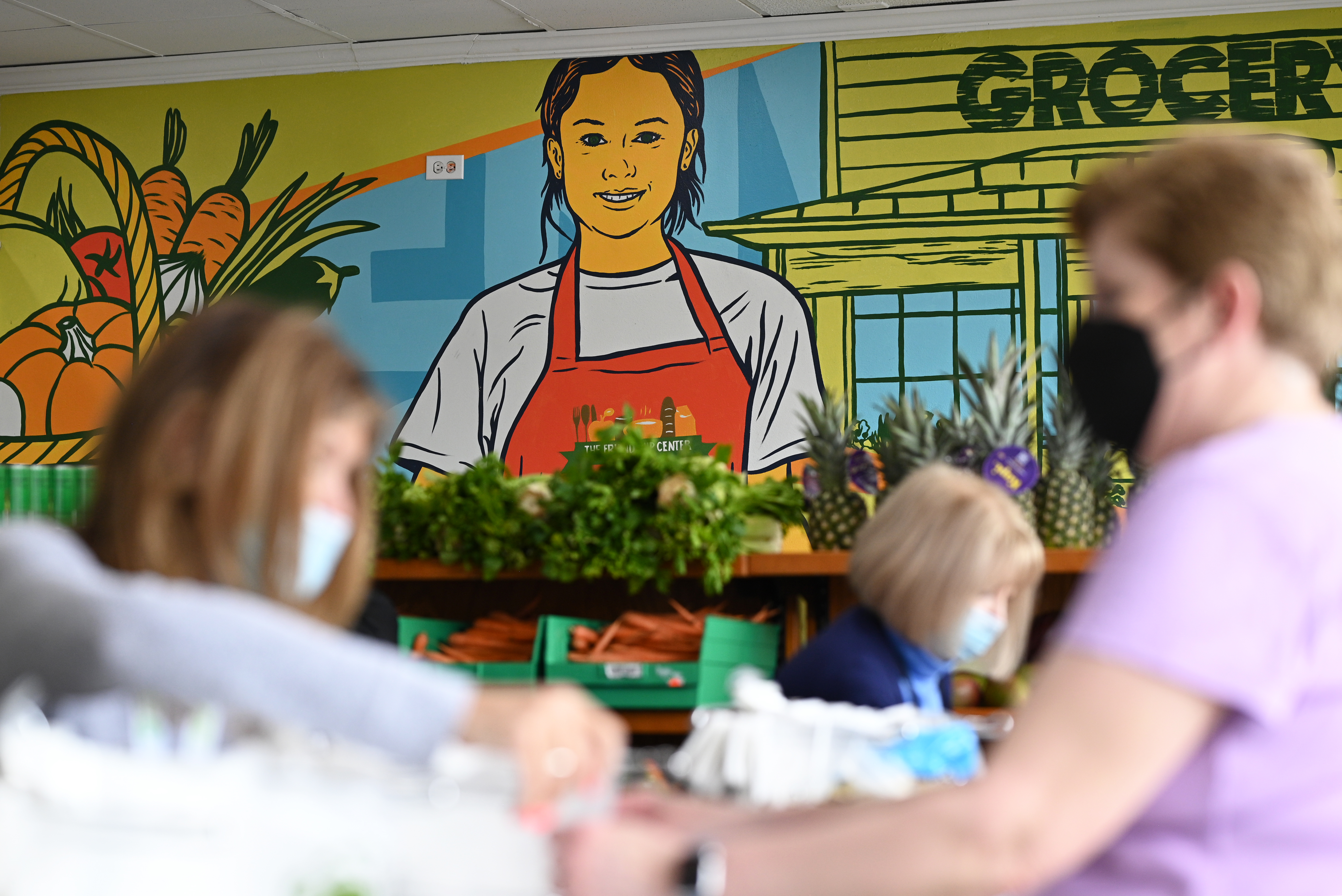
Five Ways To Fight Hunger

Every September, organizations fighting hunger come together to raise national awareness and encourage communities to take action to end hunger. 

Here are some practical ways you can take action this month. 

  1. Learn the Latest Facts About Hunger
    Food insecurity is a problem for 47 million people in the United States and 70,000 people in our 10 mile service area around The Friendship Center. 
    How many people in your community are facing hunger today? Check out Feeding America’s Map the Meal Gap tool to inform yourself about food insecurity around you. 
  1. Share About People Facing Hunger With the People Around Your Table
    Engage with the people at your dinner table, whether it be your family, friends, roommates, or neighbors, about our nation’s issue with food insecurity. We’ll share insights and education on our newsletter and social platforms about people facing hunger throughout the month. 

If you have children in your household, it is important to share about people facing hunger and help them build empathy for their neighbors who are food insecure. Help your family visualize hunger by using the following prompt:

  • What does it feel like to be hungry?
  • What would you do if you couldn’t eat for a whole day? 
  • What things might be harder to do while hungry?

Work together to draw or write a story of someone who is facing hunger. If more direction is needed, ask a question, such as: How would you feel if you had to go the entire school year without breakfast or lunch?

  1. Volunteer at Your Local Food Pantry
    You can volunteer a few hours each week and play a critical role in ending hunger for your neighbors. Some volunteer activities include sorting, bagging, distribution, client intake, dinner prep, cooking, packing meals to go, and home delivery. Additionally, volunteers are needed to help work special events like the Farmer’s Market, Oktoberfestiversary, Mayfestiversary, etc. We have a role for any level of skillset and availability. 

 Sign up for volunteer opportunities at The Friendship Center on our website

  1. Organize a Food Drive
    The number of people facing hunger in our community has grown this summer. Hosting a food drive helps keep our shelves stocked with non-perishable food and hygiene supplies. The process is simple, fill out our food drive form to get started. 
  1. Donate to End Hunger

Our neighbors rely on your generosity and partnership to foster hope and dignity through access to food and vital resources. $50 a month can feed a family of four and this month you can double your impact* thanks to a generous matching fund from neighborhood hunger fighters.

*All donations up to $5,000 will be doubled this month!

How Summer Hunger is Impacting Kids

It’s finally summer in Chicago! Kids in our community are free to play, explore, and have fun with their friends, but some will experience the “summer slide”. According to Feed the Children the summer slide happens when kids do not get the nutrition their bodies and minds need to keep developing and their abilities and knowledge regress instead of progressing over summer. 

For every four kids you see at the park laughing and playing tag, one will go home to a fridge and pantry with little to no food. 

It’s a sobering reality when we think about the fun of summertime and the mix of stressed-out parents trying to figure out how to provide enough nutritious food while struggling to make ends meet. 

Families that are enrolled in SNAP (formerly known as food stamps) have some help with paying for groceries, but during the school year, their kids are most likely receiving free or reduced breakfast and lunch at school. 

While this injustice is frustrating and saddening, you can help make a difference in the lives of families in our neighborhood. 

Through June 30, all donations up to $10,000 will be doubled, thanks to anti-hunger champions, Ted and Dawn Helwig for their match challenge. Every $1 = 16 meals. Make a difference with a gift, today.

The Friendship Center can provide a family with free fresh food and pantry items twice a month. There are no income requirements or address restrictions. We can also help families enroll in SNAP, Medicaid, and refer them to other local agencies for additional vital resources. 

Additionally, we need more friends to volunteer and help us serve the growing number of neighbors visiting the pantry every week. There are volunteer shifts every day of the week at various times. Sign in to the volunteer portal and select a time that works for your schedule.

We are grateful to be a part of a caring and generous community who seeks to alleviate hunger and help their neighbors whenever they can.

Utilizing The Food Pantry Increases Buying Power for Neighbors

Neighbors shopping at the best free grocery store in town – The Friendship Center, are walking away with an average of $160 worth of groceries. This spring, one of our student volunteers, Cora W. price compared what our neighborhood grocery stores would charge for the food that neighbors select for free during their pantry visit.

As a student, Cora is not worried about paying for housing or food but she’s learning through her classes and volunteering at TFC, that affording life’s basic necessities is costly. Cora shared, “we did a budgeting activity last year in school. It was really helpful to see all the pieces we have to put together to live. The price comparison project showed me this as well. And if we can make the puzzle a little easier for someone, I want to be part of that.”

As Cora was doing her research at local grocery stores she noted, “how hard it can be to find food in a grocery store, especially if you don’t know the layout well. A well-organized list helps.”

In addition to navigating prices and layouts of grocery stores, all of us have felt our dollars getting us less and less food when we go to check out. Our neighbors facing hunger are no exception, Cora also noticed, “while doing the price comparison project and seeing just how much food costs right in front of me, it was hard to imagine spending this much money on what I eat every week.” Your investment at The Friendship Center through donating, volunteering, and raising awareness helps alleviate neighbors from their tight budgets and allows them to redirect the $160 – $320 they are saving to other costs like utility bills, medicine, childcare, and beyond.

The Friendship Center has continued to serve more neighbors in 2024 than ever before, with a 35% increase compared to last year. To continue to provide access to fresh food and vital resources we rely on volunteers and donations to meet the needs of our neighbors.

How To Start a Food Drive

Organizing a food drive can be simple and fun. Pick out a time frame to collect donations and pick a way to motivate your community to join you. Here are some ideas on how to start one.

  • Have your community drop off donations at your home.
  • Partner with your school to be a drop-off point for donations.
    You can borrow our food drive barrels to make the collection easier. 
  • Instead of asking for birthday presents, ask for donations for your food drive. 
  • Organize a food drive with your office. 
  • Ask a local grocery store to host our food drive barrels. 
  • Ask your place of worship to collect items during the holiday season. 

There are many more creative ways to host a food drive. 

Help your community understand what types of items to donate. Here is the list of what our neighbors commonly request:

  • Rice
  • Cooking oil
  • Peanut butter
  • Jelly
  • Soy sauce
  • Easy to cook pre-made meals
  • Canned meats
  • Stews
  • Soups
  • Diapers
    Personal hygiene products

When thinking about what to donate, please keep in mind if you wouldn’t give it to a friend, we shouldn’t give it to our neighbors. 

Lastly, pick a day you can bring the donations to The Friendship Center

Here is when we are open to accept donations:
Monday: 2 – 4 p.m.
Tuesday: 3 – 7 p.m.
Wednesday: 10 a.m. – 4 p.m.
Thursday: 2 – 7 p.m.
Friday: 2 – 6 p.m.
Saturday: 10 a.m. – 1 p.m.

If you have any questions before you get started, please call us at 773.907.6388 or email info@friendshipcenterchicago.org. We cannot accept food that is left outside.

Thanks for fighting hunger by feeding your neighbors.

Download our food drive toolkit to save this information for later.

Why Does Food Rescue Matter?

“I have some crates of milk  for you that we have too much of this week .” Brandon, the milkman, at our neighborhood Mariano’s is eager to provide our neighbors with the excess stock his store receives. 

Seth, our driver, visits stores throughout the city each morning to rescue excess food. From baked bread, vegetables, milk, eggs, meat, and everything in between, food rescued from grocery stores feeds our neighbors. 

Food rescue also creates a more sustainable supply chain. Grocers can forecast supply and demand at different times of the year however there is always some food that goes unsold. When stores donate fresh food and non-perishable items to The Friendship Center, they are eliminating excess food waste. 

“According to ReFED, 35% of food, or 80.6 million tons, goes uneaten or unsold in the United States – and most of that goes to waste.” (Feeding America, 2023). 

Food waste can also happen because of cosmetic issues like the item is too long, discolored, or oddly shaped, and retailers do not want to carry those items.

Additionally, the packaging could be mislabeled and missing the allergen information, so the items aren’t able to be sold in stores. Our network partner, Feeding America, is the only FDA-trusted organization with the ability to relabel food so that allergies can properly be listed and items can be donated to people facing hunger. 

Many manufacturers produce different types of products using the same machinery. It’s almost impossible to have some items not turn out correctly. For example, a plant that packages crunchy and creamy peanut butter will inevitably have a few batches that mix creamy and crunchy due to switching the type of consistency during production. Retailers do not want to carry these items as it can decrease customer satisfaction.

Cosmetic issues do not make food inedible. The network of food banks and pantries across the country can rescue these items from farmers, manufacturers, and retailers and redistribute them to the community. 

Check out this challenge from Feeding America to see if you can spot which food items would end up in a landfill instead of the grocery store. 

As a community, The Friendship Center partners with our neighborhood grocers to prevent healthy and fresh food from ending up in the trash and instead go to people who need it but cannot afford it. In the last twelve months we have rescued more than 500,000 lbs of wholesome food. To put that into perspective that is about a month of meals for 463 people! 

We are grateful to partner with Jewel #3262, Jewel #1282, Jewel #3442, Mariano’s #522, Mariano’s #515, Tony’s Fresh Market #567, Tony’s Fresh Market #1167, GoPuff #1, and Costco. We also continue to add new partnerships that will support our neighbors.

During Hunger Action Month we encourage you to fight hunger by partnering with us. $50 a month can feed a family of four and this month you can double your impact* thanks to a generous matching fund from John and Erin Telford. 

*All gifts up to $3,000 will be matched.

Poverty is Not a Mindset

Poverty is not a mindset.  Poverty is a systemic failure.

We often hear that everyone can make it if they would just put forth the effort; that it is their own fault if they are poor. This is untrue.  Many of those that are living on the margins and in the shadows of society have literally been forgotten.  Decades of policy choices have created the dramatic increase in poverty that we are now experiencing. Systems and governmental barriers prevent those living in poverty conditions from escaping. 

As a child, if you grow up in a neighborhood that makes no investment in you, that dismantles your neighborhood by closing schools and stores, blocks transportation access, that removes all resources from your community, you will be impacted.  There is no way you wouldn’t be.  And these experiences help frame our lives and the decisions we make. In fact, most people experiencing chronic homelessness struggle with what we call ACEs (Adverse Childhood Experiences). 

We are a reactive society, which is one of our biggest downfalls.  We have devalued the lives of children.  These children will grow into adults.  We then expect those adults to operate effectively, with rational thought and make good decisions.  What we don’t recognize is that these adults were the children that ate Cheetos and juicy boxes for breakfast on the way to school.  These are the children we didn’t invest in and gave up on.  How can they thrive in conditions like this?  

People, especially those that deal with chronic homelessness, need more than a roof over their head – if they even want that.  They need wrap around case services, support, therapeutic healing, mental health services, etc. For example, California is expecting a budget surplus of close to $98 Billion in 2023.  Gov. Newsome will be adding an additional $700 Million to his proposed budget of $2 Billion for housing solutions.  Although this budget increase is commendable, instead of addressing the issues at the root of the problem money is thrown at housing.  This rarely works. 

As I teach my NEIU students in our “Hunger and Homelessness” Justice Studies class, no one grows up wanting to be poor or chronically unhoused.  Systemic barriers and decades of failure have led us here to where we are today.  Failing to provide proactive strategies and solutions, like investing in housing without addressing mental health, is not a legitimate path forward.

-Gaylon Alcaraz, Justice Studies – NEIU


About the author:

Gaylon comes from a long history in Chicago as an activist, organizer and champion of human rights.  For more than twenty five years, she has worked on behalf of sexual minority women, anti-violence, gender equity, health prevention, reproductive rights, as well as race and culture issues. She has consistently applied her knowledge in practice towards quality improvement, increased access, and by challenging frameworks that do not allow for the exploration of diversity across multiple dimensions when working with, and on behalf of diverse constituencies.  Gaylon is the past Executive Director of the Chicago Abortion Fund and is a founding board member of Affinity Community Services, a past board member of the Illinois Caucus for Adolescent Health and the Midwest Access Project. Currently, she is the Director of Operations with the Marsha P. Johnson Institute.

Born and raised in Chicago, Illinois she was awarded her BA and MA from DePaul University.   Gaylon is currently a PhD candidate in Community Psychology at National Louis University.