How Summer Hunger is Impacting Kids

It’s finally summer in Chicago! Kids in our community are free to play, explore, and have fun with their friends, but some will experience the “summer slide”. According to Feed the Children the summer slide happens when kids do not get the nutrition their bodies and minds need to keep developing and their abilities and knowledge regress instead of progressing over summer. 

For every four kids you see at the park laughing and playing tag, one will go home to a fridge and pantry with little to no food. 

It’s a sobering reality when we think about the fun of summertime and the mix of stressed-out parents trying to figure out how to provide enough nutritious food while struggling to make ends meet. 

Families that are enrolled in SNAP (formerly known as food stamps) have some help with paying for groceries, but during the school year, their kids are most likely receiving free or reduced breakfast and lunch at school. 

While this injustice is frustrating and saddening, you can help make a difference in the lives of families in our neighborhood. 

Through June 30, all donations up to $10,000 will be doubled, thanks to anti-hunger champions, Ted and Dawn Helwig for their match challenge. Every $1 = 16 meals. Make a difference with a gift, today.

The Friendship Center can provide a family with free fresh food and pantry items twice a month. There are no income requirements or address restrictions. We can also help families enroll in SNAP, Medicaid, and refer them to other local agencies for additional vital resources. 

Additionally, we need more friends to volunteer and help us serve the growing number of neighbors visiting the pantry every week. There are volunteer shifts every day of the week at various times. Sign in to the volunteer portal and select a time that works for your schedule.

We are grateful to be a part of a caring and generous community who seeks to alleviate hunger and help their neighbors whenever they can.
Utilizing The Food Pantry Increases Buying Power for Neighbors

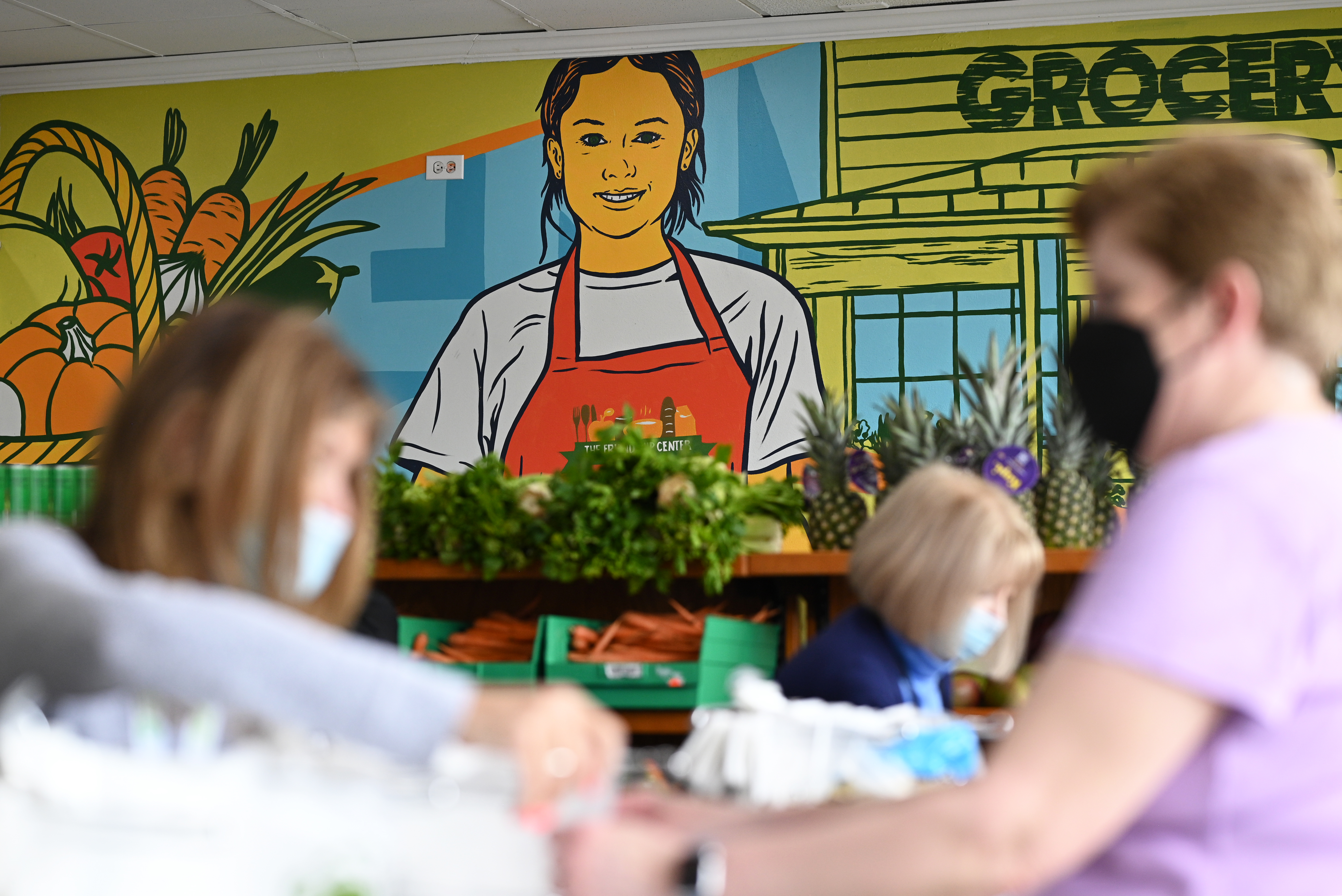
Neighbors shopping at the best free grocery store in town – The Friendship Center, are walking away with an average of $160 worth of groceries. This spring, one of our student volunteers, Cora W. price compared what our neighborhood grocery stores would charge for the food that neighbors select for free during their pantry visit.

As a student, Cora is not worried about paying for housing or food but she’s learning through her classes and volunteering at TFC, that affording life’s basic necessities is costly. Cora shared, “we did a budgeting activity last year in school. It was really helpful to see all the pieces we have to put together to live. The price comparison project showed me this as well. And if we can make the puzzle a little easier for someone, I want to be part of that.”

As Cora was doing her research at local grocery stores she noted, “how hard it can be to find food in a grocery store, especially if you don’t know the layout well. A well-organized list helps.”

In addition to navigating prices and layouts of grocery stores, all of us have felt our dollars getting us less and less food when we go to check out. Our neighbors facing hunger are no exception, Cora also noticed, “while doing the price comparison project and seeing just how much food costs right in front of me, it was hard to imagine spending this much money on what I eat every week.” Your investment at The Friendship Center through donating, volunteering, and raising awareness helps alleviate neighbors from their tight budgets and allows them to redirect the $160 – $320 they are saving to other costs like utility bills, medicine, childcare, and beyond.

The Friendship Center has continued to serve more neighbors in 2024 than ever before, with a 35% increase compared to last year. To continue to provide access to fresh food and vital resources we rely on volunteers and donations to meet the needs of our neighbors.

The Power of a Dollar

In today’s economy there is not much you can do with a dollar, let alone five dollars. It’s rare to afford a convenience meal or a drink from a coffee shop for $5 or less today too.

However, The Friendship Center has optimized our dollars making it possible for donated dollars to go further.

Through our food rescue program, we partner with local grocers: Jewel, Mariano’s, Tony’s Fresh Market, Costco, and GoPuff to receive a variety of items each week and prevent avoidable food waste. We receive a weekly order from the Greater Chicago Food Depository of canned items, fresh produce, dairy products, eggs, meat, and fish.

Supportive neighbors also host food drives and we receive donations from urban farms, gardens, and bakeries.

Due to the quantity of food that is donated to us every year, donated dollars are able to amplify the mission by supporting operating costs, providing access to vital resources and purchasing food.

At The Friendship Center, $1 = 8 meals

How the math breaks down: We take the total pounds of donated food we receive in a year and divide that by our operating expenses to distribute the food, and it comes out to 9.5 lbs per every dollar. Every meal is roughly 1.2 lbs.

When you donate to The Friendship Center, every dollar is being optimized to foster hope and dignity and provide access to food and vital resources to our neighbors facing hunger.

Give today to ensure our neighbors have access to fresh food and vital resources this year.

Poverty is Not a Mindset

Poverty is not a mindset.  Poverty is a systemic failure.

We often hear that everyone can make it if they would just put forth the effort; that it is their own fault if they are poor. This is untrue.  Many of those that are living on the margins and in the shadows of society have literally been forgotten.  Decades of policy choices have created the dramatic increase in poverty that we are now experiencing. Systems and governmental barriers prevent those living in poverty conditions from escaping. 

As a child, if you grow up in a neighborhood that makes no investment in you, that dismantles your neighborhood by closing schools and stores, blocks transportation access, that removes all resources from your community, you will be impacted.  There is no way you wouldn’t be.  And these experiences help frame our lives and the decisions we make. In fact, most people experiencing chronic homelessness struggle with what we call ACEs (Adverse Childhood Experiences). 

We are a reactive society, which is one of our biggest downfalls.  We have devalued the lives of children.  These children will grow into adults.  We then expect those adults to operate effectively, with rational thought and make good decisions.  What we don’t recognize is that these adults were the children that ate Cheetos and juicy boxes for breakfast on the way to school.  These are the children we didn’t invest in and gave up on.  How can they thrive in conditions like this?  

People, especially those that deal with chronic homelessness, need more than a roof over their head – if they even want that.  They need wrap around case services, support, therapeutic healing, mental health services, etc. For example, California is expecting a budget surplus of close to $98 Billion in 2023.  Gov. Newsome will be adding an additional $700 Million to his proposed budget of $2 Billion for housing solutions.  Although this budget increase is commendable, instead of addressing the issues at the root of the problem money is thrown at housing.  This rarely works. 

As I teach my NEIU students in our “Hunger and Homelessness” Justice Studies class, no one grows up wanting to be poor or chronically unhoused.  Systemic barriers and decades of failure have led us here to where we are today.  Failing to provide proactive strategies and solutions, like investing in housing without addressing mental health, is not a legitimate path forward.

-Gaylon Alcaraz, Justice Studies – NEIU


About the author:

Gaylon comes from a long history in Chicago as an activist, organizer and champion of human rights.  For more than twenty five years, she has worked on behalf of sexual minority women, anti-violence, gender equity, health prevention, reproductive rights, as well as race and culture issues. She has consistently applied her knowledge in practice towards quality improvement, increased access, and by challenging frameworks that do not allow for the exploration of diversity across multiple dimensions when working with, and on behalf of diverse constituencies.  Gaylon is the past Executive Director of the Chicago Abortion Fund and is a founding board member of Affinity Community Services, a past board member of the Illinois Caucus for Adolescent Health and the Midwest Access Project. Currently, she is the Director of Operations with the Marsha P. Johnson Institute.

Born and raised in Chicago, Illinois she was awarded her BA and MA from DePaul University.   Gaylon is currently a PhD candidate in Community Psychology at National Louis University. 

Food Waste Reduction Efforts at The Friendship Center

Earth Day is April 22, and Stop Food Waste Day is April 27, so it seems like a perfect time to highlight the issue of food waste and the ways that The Friendship Center is working to reduce wasted food while improving service for our clients.

Food waste has enormous environmental, ethical, and economic impacts. According to ReFED, a whopping 35% of all food in the U.S. was either unsold or uneaten in 2019, representing $408 billion worth of food. When food is wasted it also wastes all the land, water, energy, labor, and love that goes into producing it. And when food decomposes in landfills, it generates greenhouse gasses that contribute to climate change. In fact, food waste accounts for 4% of total greenhouse gas emissions in the U.S.

This level of food waste is happening at the same time that 1 out of 6 Americans struggle with food insecurity. Within The Friendship Center’s service territory, 1 in 3 people, or 66,000 of our neighbors, are food-insecure.

While there are many systemic reasons for this disconnect, food waste is a solvable problem. The EPA’s Food Recovery Hierarchy suggests that beyond source reduction (prevention), the best option for reducing food waste is to Feed Hungry People, which, of course, is our mission at The Friendship Center.

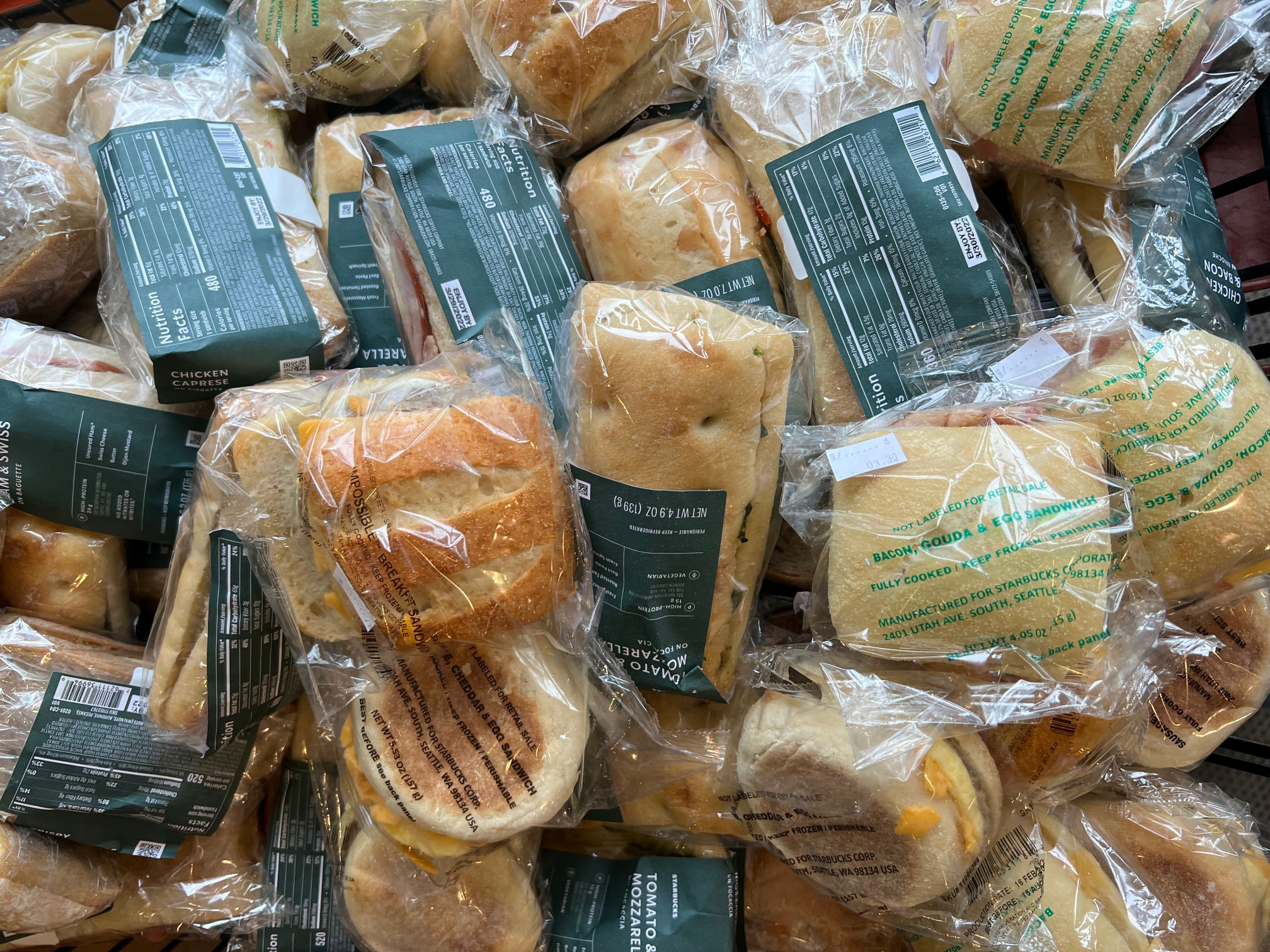
The Friendship Center currently rescues and redistributes unsold, high quality food from a handful of local retailers to augment our inventory. Donations include meat, fresh produce, dairy, baked goods , and shelf-stable items.

Even more exciting is that with our new grants from Swedish Covenant Hospital and the Greater Chicago Food Depository, The Friendship Center is currently renovating our facility.  Increasing our cold storage capacity and acquiring a new van will allow us to significantly expand our food rescue efforts and increase the amount and variety of culturally-relevant foods we can offer our clients.

Farther down the Food Recovery Hierarchy is composting, which is one more way that The Friendship Center is working to reduce food waste. Composting is a way of recycling food scraps and turning them into a nutrient-rich soil amendment. Foods in our inventory that go past their prime, as well as food scraps from our hot meals prep, are placed in toters out back and collected weekly by a compost collection service.

The Friendship Center is looking forward to expanding our food rescue efforts in the future– for the health of our neighbors and the health of our planet.

 – Susan Casey


About the author:

Susan Casey has served on The Friendship Center board since April 2021. She is the Zero Waste Schools Program Manager at the nonprofit Seven Generations Ahead, where she works with K-12 schools to reduce waste. Susan is a member of the Wasted Food Action Alliance and the Illinois Food Scrap Coalition.